Blog

Good health!

By Roberta Beer

For many centuries, it has been traditional for country folk in Britain to light fires, sing songs and drink cider in the orchards on the Twelfth Night after Christmas, to wish the apple trees Good Health and New Year, as well as to each other. This ancient tradition is called wassailing.

Wassail means ” Good Health”. (The response, by the way, to the toast of “Wassail!” is “Drink Hail!” ). There was much merriment and cider drinking on Twelfth Night, as villagers lit fires in the orchards, sang traditional songs, and toasted the trees.

On this day, villagers also anointed with cider their chickens and other animals and brought the village plough into the church to be blessed by the priest. Peasants visited “the big house” to toast the landowner and his family. In return, servants filled the large two-handled “wassail cup” with cider and distributed food to the singers. 

The wassail typically starts with a procession to the orchard, led by a wassail King or Queen. Pieces of toast are placed in the branches to attract robins, which are believed to be guardians of the orchard. The revellers bang pots and pans to wake the tree spirits and to drive away any bad spirits from the land and they enjoy a wassail drink of spiced cider or ale.

Wassailing at HCF

We have three orchards at Highbridge Community Farm and we’ve honoured this ancient tradition of blessing the trees with singing and food and drink. For the wassail, the team nominated one tree in each of our orchards to represent The Green Man, to bring fertility and good harvests to the whole Farm.

Photo: Highbridge Community Farm

Beating the bounds

This is another ancient custom. When maps were rare, a community would periodically walk around its boundaries, beating the boundary markers with a pole as a way of maintaining the memory of the location of these boundaries. We combine this into our wassail ceremony by walking around our three orchards, “beating” the trees with a bean pole.

Wassail songs

Here are a couple of the traditional songs for the wassail. The first is more general for the celebration. The second is specifically for the apple trees.

Here we come a-wassailing

Here we come a-wassailing, among the trees so green.
Here we come a-wandering so fair to be seen.

Chorus
Love and joy come to you
And to your Wassail too.
And God bless you and send you a Happy New Year,
And God send you a Happy New Year.


We are not daily beggars that beg from door to door,
But we are your neighbours children, whom you have seen before.

Chorus

Good Master and good mistress too, às you sit beside the fire,
Pray think of us poor children, who wander in the mire.

Chorus

Bring us a table and spread it with a cloth.
Bring us out, some mouldy cheese and some of your Christmas Loaf.

Chorus

God Bless the Master of this house likewise his mistress too
And all the little children that round the table go.

Chorus

Apple tree wassail

Old apple tree, we wassail thee
Hoping that thou will bear
For the Lord know where we shall be
To be merry another year

Chorus
For to bloom well and to bear well
And merrily shall we be.
Let everyone drink up their glass
And health to the apple tree
For to bloom well and to bear well
And merrily shall we be.
Let everyone one drink up their glass
And health to the apple trees, brave boys
Here’s health to the apple tree

Oh, apple tree, we Wassail thee,
Hoping thou wilt bear
Hatfuls, cap-fuls, three bushel bag-fulls
Many more under the stairs.

Chorus
Meet our artist

If you’ve wandered past Plots 3 and 4 recently, you might have noticed someone with a camera in hand, quietly observing or capturing the gentle ebb and flow of life on Highbridge Community Farm. That’s me – Jo Rose. I’m a full-time artist based in Winchester, where I work from my studio on Jewry Street.

Photo: Jo Rose

Rooted in the natural world

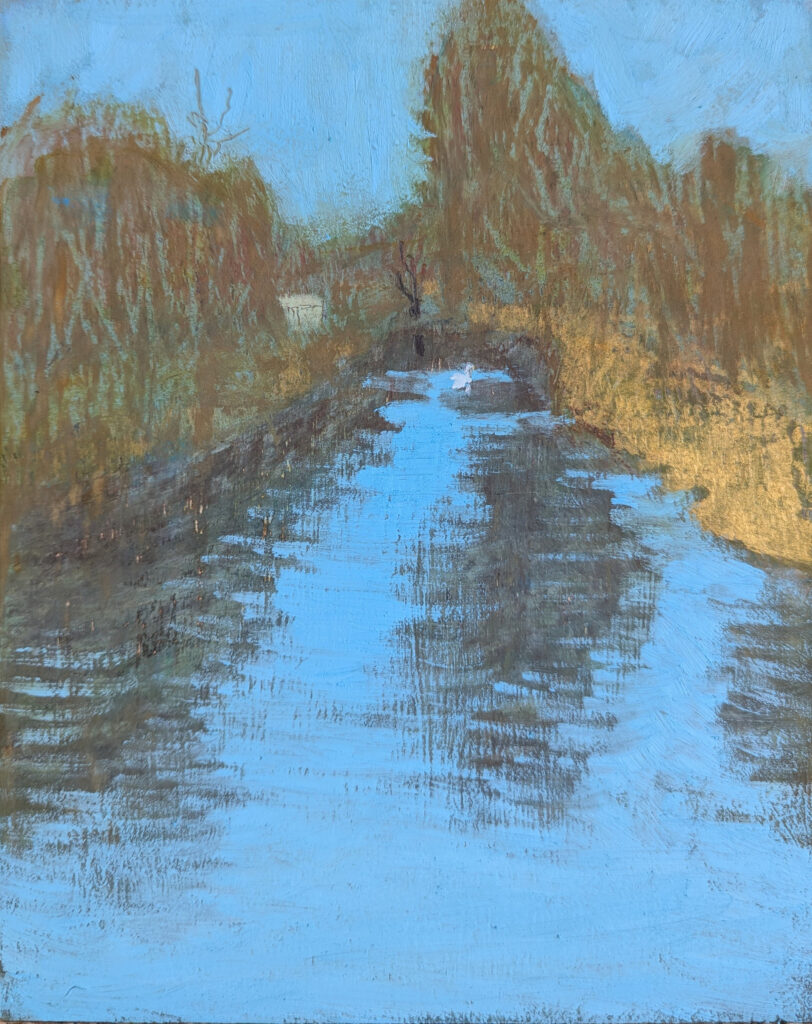
My artistic practice is is deeply rooted in the natural world. I paint and illustrate abstract impressionist landscapes using oils and mixed media, drawing inspiration from the beauty of the New Forest and the River Itchen. My work often features the wildlife I encounter on my walks and I’m especially inspired by the shifting colours and textures of the seasons, and the changing light on the river.

Photo: Jo Rose

This year is shaping up to be both busy and exciting. I’m currently preparing for several exhibitions, starting with a group show with the Artful Collective at the beautiful Hillier Gardens this July. In August, I’ll be exhibiting a solo collection in Falmouth, and in October, I’m curating an immersive group show in Winchester city centre, all inspired by nature.

My Highbridge project

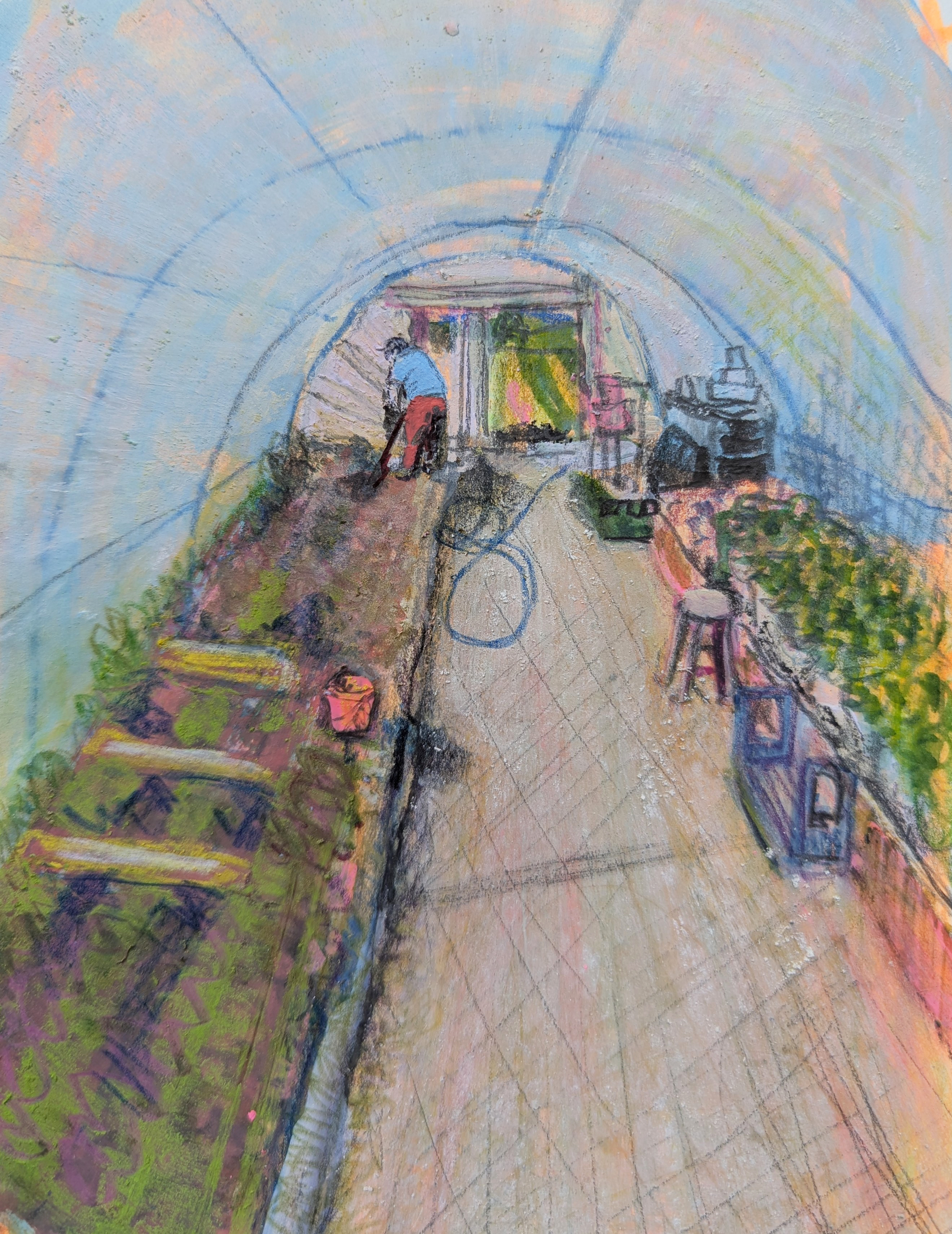
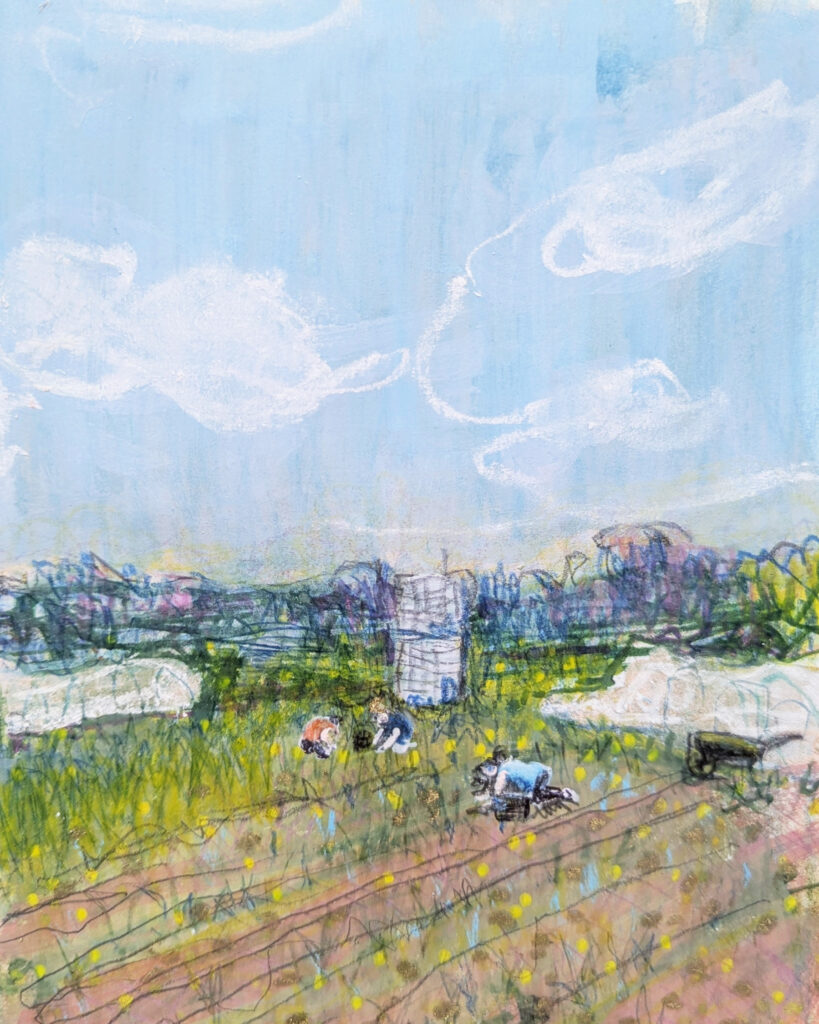
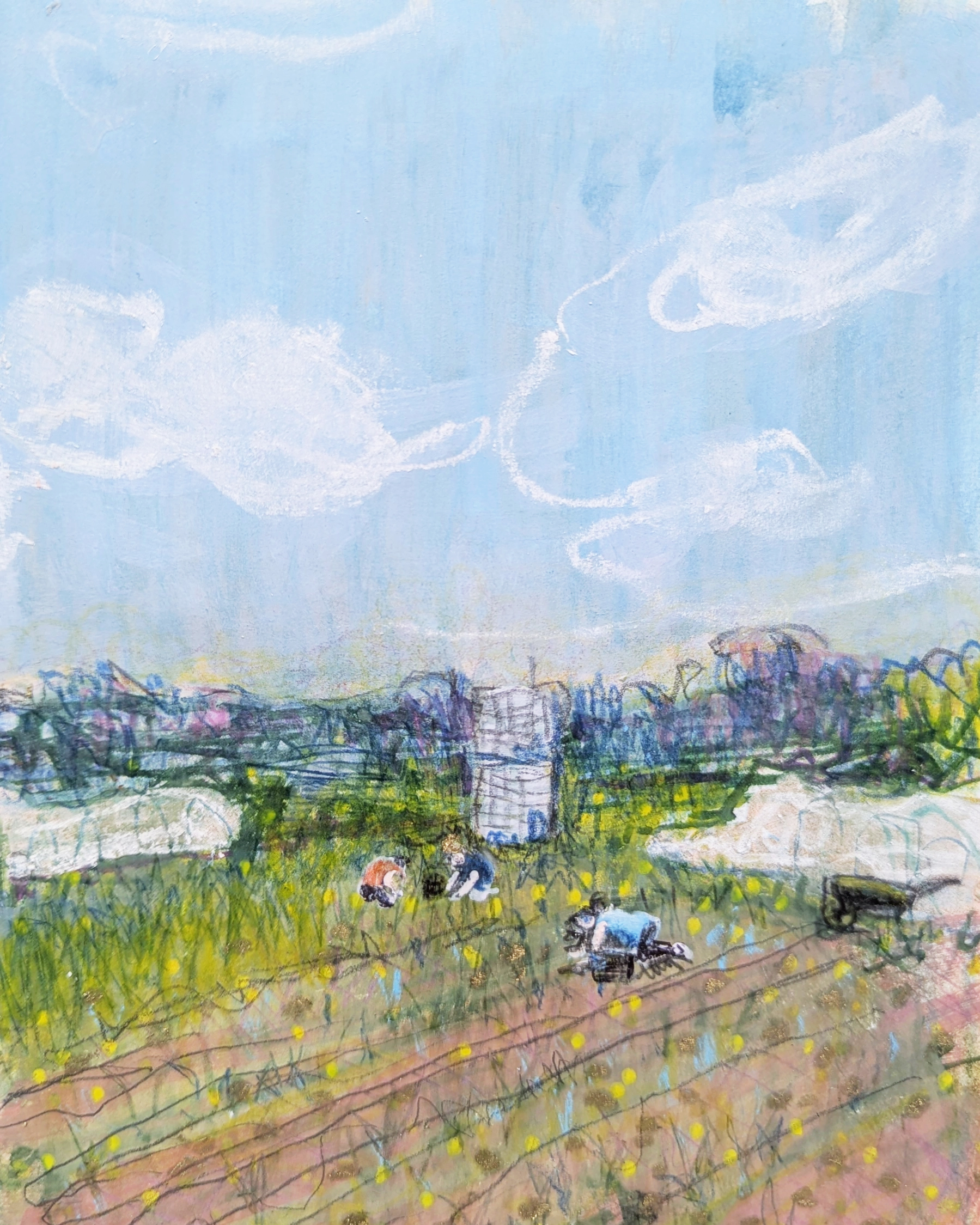
Amid all this, I’m embarking on a personal project: a sketchbook series that documents my time here at Highbridge Community Farm. The photographs I take often evolve into illustrated journal entries—more than just drawings, they become a visual diary of our shared work, quiet moments of connection, and the stories that make this place so special. This project is also pushing me out of my comfort zone as I begin to illustrate people more often, helping me to expand and develop my practice in new directions.

Photo: Jo Rose

Having been a member of the farm for many years, I’ve come to see it as much more than just a place to grow fruit and vegetables. It has offered me friendship, peace, and a sense of grounding through difficult times. The Farm is a wonderfully inspiring community—one that nurtures both the land and the people who care for it. My sketchbooks aim to celebrate this spirit: the collaboration, the care, and the joy that comes from growing together.

If you and your team are working on something interesting and wouldn’t mind being photographed, I’d love to hear from you. This is a collaborative journal, and I’d be delighted to include more of our collective story. And if you’re curious about my work, feel free to stop by Plots 3 and 4 for a chat.

You can find out more about my work at www.jorosestudio.co.uk or on Instagram @jo_rose_studio.

Photo: Jo Rose

Digging into the earthworm survey

Earthworms are key indicators of soil health and ecosystem function so we’ve been checking on the numbers of earthworms in our soil at HCF for several years now. What have our surveys revealed? Andrew Ross explains.

Earthworm sampling is valuable at Highbridge Community Farm because earthworms are key indicators of soil health and ecosystem function. Their presence and diversity reflects soil fertility and the overall health of the ecosystem.

Earthworm activity, including their burrowing and castings, improves soil structure, aeration, and water infiltration, all of which are crucial for plant growth and overall soil fertility. The earthworms helps to create and maintain soil structure, which is essential for healthy root growth and water retention. 

Earthworm sampling is one of a few ways we monitor the health of our soil. We also have a nutrient analysis conducted every two years or so, which tells us the levels of organic matter.

Three types of worm

We identify three types of worms, described below, and juveniles which have not yet developed a saddle. To find out more about how we take the sample, see one of our previous blogs, Worming our way into soil health.

Epigeic worms (surface worms) 

  • These worms live in the leaf litter at the surface.
  • Dark, red-headed worms. They are of small size (less than 8cm).
  • Often fast-moving (good for escaping from birds and most likely to escape from the worm pot!)
  • Sensitive to: digging (which is detrimental) and a lack of organic matter on the surface. They are prey for native birds.

Endogeic (topsoil earthworms)  

  • Pale-coloured and green worms (not red)
  • Small to medium size 
  • Often curl up when handled. These are the most common earthworm group in our plots.
  • Sensitive to: Increased organic matter (beneficial) 
  • Roles: Nutrient mobilisation for plants

Anecic  (deep burrowing earthworms) 

  • Milky-coloured worms, with increasing red or black pigmentation towards the head. 
  • Large size (over 8 cm), typically similar size to a pencil. Make deep vertical tunnels, up to 2m. 
  • Often found below surface earthworm casts or midden residue piles. Feed at night, foraging the soil surface around their burrow for litter.
  • Often absent from ploughed fields (ploughing destroys their burrows) and where there is no surface litter.
  • Roles: Deep burrows that improve aeration, water infiltration and root development. 

A traffic light system to assess the results

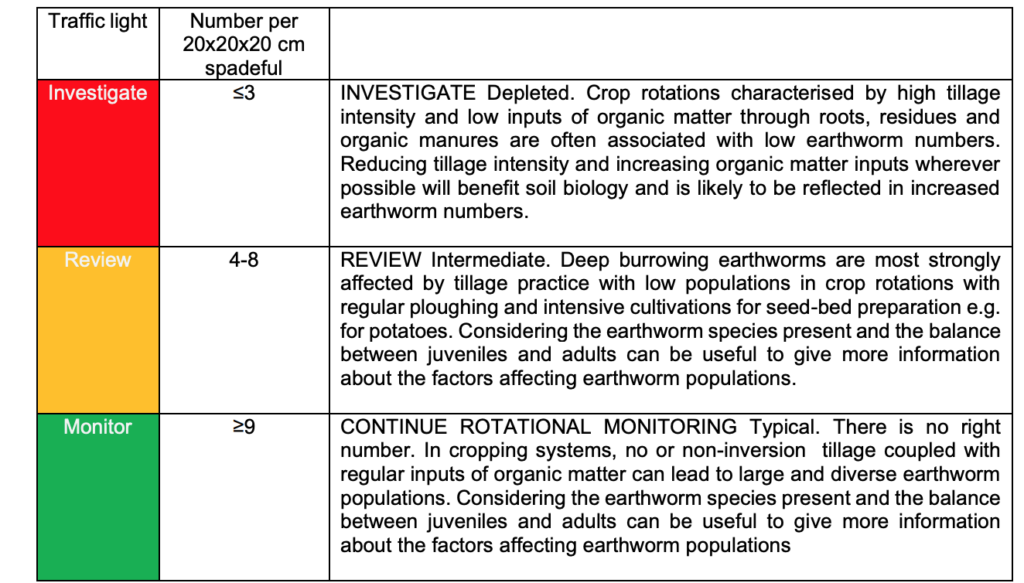
A traffic light system to give an indication of the results has been developed by the Agriculture and Horticulture Development board (AHDB) for the sampling technique that we have used.

Comparing results over time

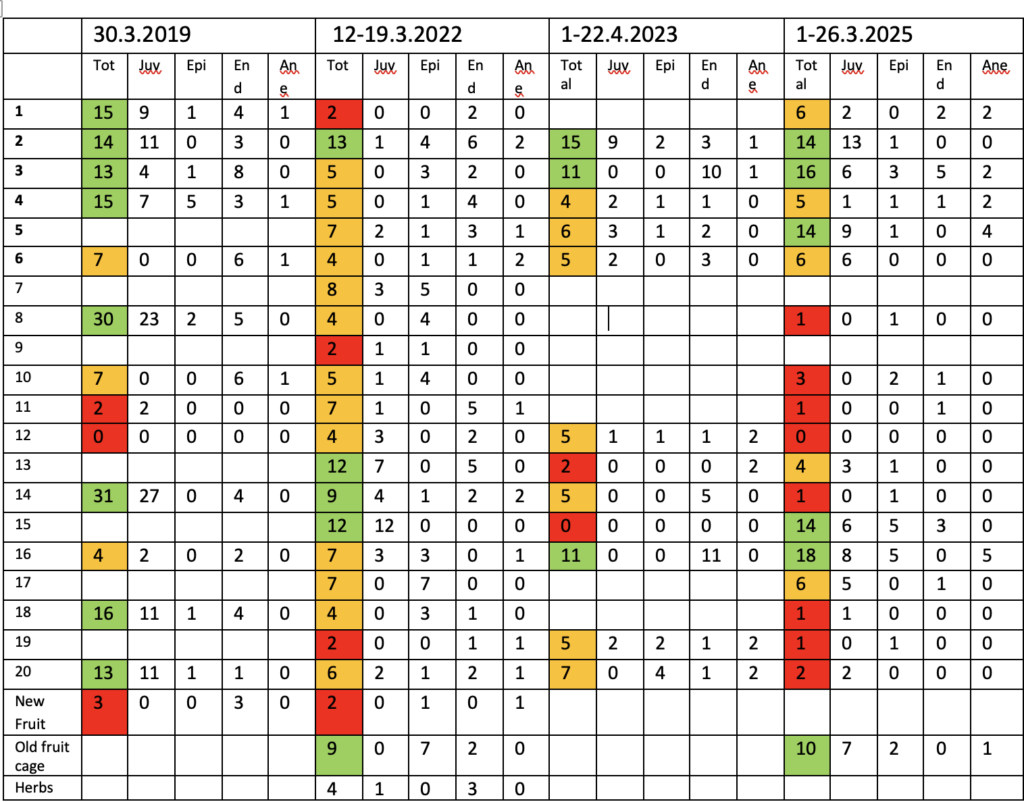
We have been counting the numbers of earthworms on our plots since 2019 to gain an impression of soil health. This table compares the results from March 2019, March 2022, April 2023, and March 2024 compared, with the plots on the left. The colours in the first column of the data come from the Agriculture and Horticulture Development Board’s traffic light system.

The 2025 results suggest that there are a surprising number of plots where the sample revealed very low numbers of worms (identified by the red or orange boxes).

Other plots (identified in green) seem to be doing well with several plots recording worm counts of 14-18 worms per sample.

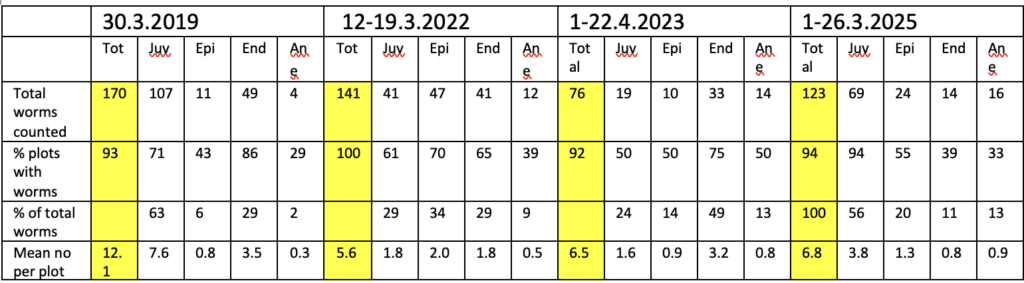
Summary of results across the Farm

What do the results suggest? 

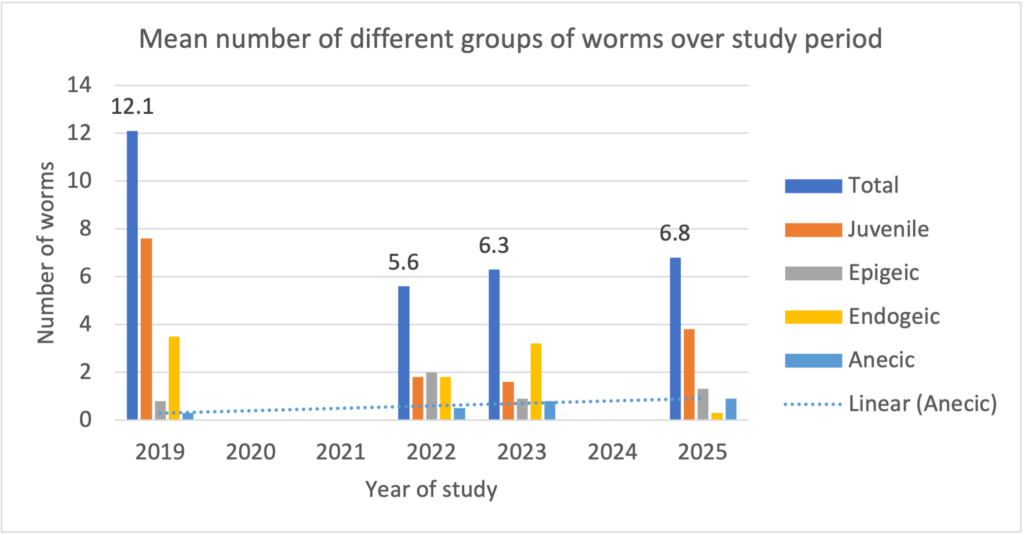
Estimates of the total numbers of worms went down from 2019 until 2022 but they have been rising slowly since. We are not sure why. Is it changes in the weather? Or changes in the soil? Or have numbers been affected by more moles moving into the site? (Moles only move into rich areas of soil which is an encouraging sign of soil quality.) However, an ecological principle is that predators (the moles) do not determine the population size of the prey (the worms) so the presence of moles is unlikely to be the cause of the decline in worm numbers.

As you can see from the graph below, there have been changes in the percentages of each of the three types of worms and the percentage of juvenile worms, but because of the relative inexperience of some people undertaking the identification, there are likely to be a significant proportion of worm misidentifications.  It is good to see a small rise in average numbers of epigeic worms per plot, which suggests that more organic matter is being left on the surface for these worms to hide in and feed on. It is also good to see a small rise in average numbers of anecic worms per plot and this may be because an increasing number of plots are adopting a “no-dig” approach and so their burrows are not being damaged by digging and remain intact. It is disappointing to see a decline in the numbers of endogeic worms.

We still cannot account for the very low total worm numbers on certain plots. In future years, we suggest that plots with very low numbers which bear a red flag are repeat sampled (perhaps by more experienced samplers) to try to determine whether this is a random sampling error or if this is uniform across the plot and the low worm numbers are the result of an unhelpful growing practice.

Earthworm sampling continues to give us valuable insights into the health of the soil that we need for successful crops. Please let Andrew Ross know of any thoughts you have.

HCF goes edimental

Plot 3 at Highbridge Community Farm has a new set of plants: edimentals. What are these? And why are we interested in growing them? Andrew Ross explains.

An edimental plant is a dual purpose plant: edible + ornamental. Some of them are short-lived perennials so they keep coming up year after year.  We hope that growing edimentals might reduce the amount of labour that we need to grow a crop and, at the same time, increase the visual attractiveness of the plots. 

It’s not just us showing interest in these plants. Garden designer Harry Holding created a whole show garden at Chelsea 20023 based around edimentals. He explains the concept like this: “Edimentals are in the sweet spot of plants that both look nice, are edible, and generally live for three years or longer (ie they are perennial). Traditional food growing is more of a seasonal annual cycle, but with edimentals, once you’ve planted it or sown seeds, they are resilient and have longevity.”

Getting started

We began the project in spring 2024 by planting several different species at the “Roman Road” end of Plot 3. The only one which was eaten by a number of Farm members last year was the purple-leaved tree spinach Chenopodium giganteum. We had high hopes for the Caucasian Spinach, Hablitsia tamnoides, but it was not able to cope with the bright sunlight and sadly, it died. We will try growing it again this year in more shade. It’s a great perennial leaf vegetable.

This year’s plants

We managed to collect seed from two single specimens of red flowered Love-lies-bleeding Amaranth varieties,  Amaranthus caudatus and A. cruentos, that were grown in the plot last year as well as the seeds of several Tree Spinach plants. We’ve drift-sown these seeds in the edimental garden during March 2025. We have also already managed to plant a small area with seedlings of the Orache Atriplex hortensis, whose red leaves will work well cooked or make a great addition to a salad or cooked.    

Four other plants survived last year’s winter: sea kale Crambe maritima, the cabbage thistle Cirsum oleraceum, Korean Celery Dystaenia takesimana and borage Borago officinalis. The borage died back but has returned this spring. The Korean Celery stood strong through the winter cold and should bush up this year.

This year, we’re also putting in new plants, including cuttings of a very old variety of kale called Taunton Dene and another whose thick straight stem earned it the name of Jersey Walking Stick Kale. We’ve sown seeds of the legume Pigeon peas Cajanus cajan and the Siberian pea tree Caragena arborescens and we are waiting to see if they come up. 

We plan to try to grow some of our interesting onion varieties in pots before we plant them out because they were rather swamped by weeds last year. Perhaps the most exciting of these is the Sicilian honey garlic, Allium siculum, which has attractive, pendulous mauve flowers.

Find out more

The edimentals look good on Plot 3 but they also give us a chance to learn about growing different plants and to include plants in our food that we can’t buy commercially. If you’d like to know more about our edimentals, find Andrew Ross at the Farm – and do let us know what you think about this new growing venture.

New grant helps us to get water to the plots

We use the money from stakeholder subscriptions and the sale of produce to buy most of what the Farm needs. We usually plan infrastructure projects in stages, according to what we can afford . This year, one of our projects is getting a boost from a local grant.

Southampton Airport Spitfire Wellbeing Fund

The recently-established Southampton Airport Community Health and Wellbeing Fund provides financial support to certain types of local community organisation, charities and groups. These groups must support initiatives that reduce health inequalities and improve health and wellbeing. The fund focuses on three areas:

  • Physical activity
  • Mental wellbeing
  • Access to open spaces, including green space.

Highbridge Community Farm meets the criteria. We’re just a few miles from Southampton Airport and we aim to give our members benefits in all three of the Fund focus areas. So, a small group of HCF members put together an application for funding to upgrade our irrigation system .

Our watering challenge


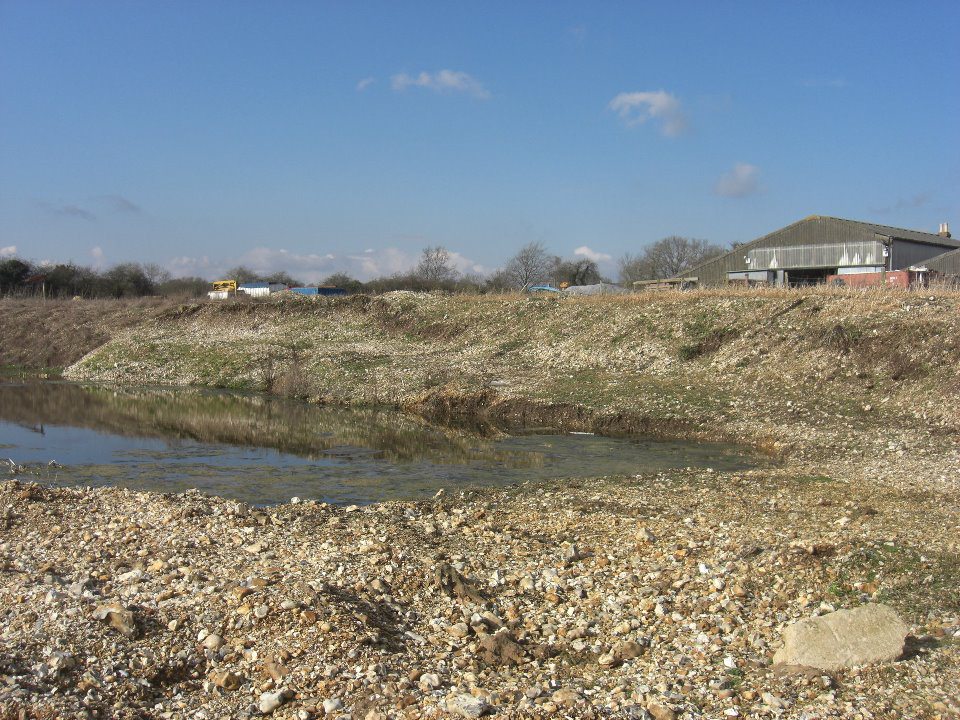
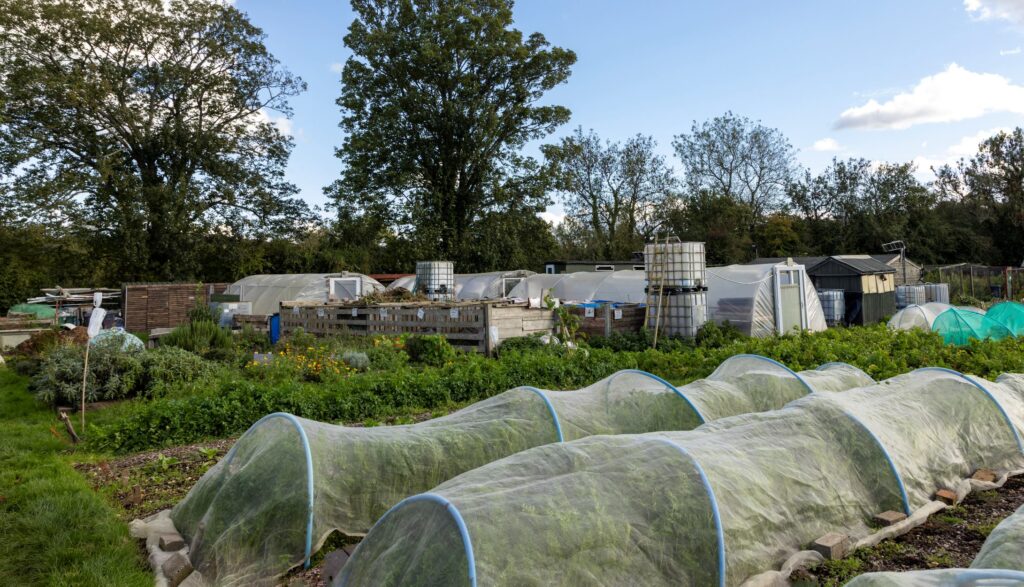
We have 20 vegetable plots, four orchards, and a Soft Fruit area – and they all need water for the crops to thrive. We’re lucky to have access to a balancing pond on site but getting the water from there to the plots has been a long-standing challenge. Any HCF member with at least one summer of experience will recognise the work involved!

When the Farm project first started, the team had to lug watering cans from the pond to the plots. The first evolution of our system brought a petrol pump in the pond to pump water through donated fire hoses into ten Intermediate Bulk Containers (IBCs) situated at each pair of plots. This made water accessible to the plots without the long trek to the pond for each watering can – but it was still tough. Some areas were still a fair way from an IBC and, without careful coordination, teams could find the IBCs empty of water.

In line with our commitment to reduce chemical and fossil fuel use, in 2022, we installed an electric pump in the pond. The pump is powered by two second-hand batteries and charged by a second-hand solar system. This drip-fills the 10 IBCs through permanent, underground piping.

In mid-2023, the irrigation system was expanded to include additional IBCs and to reach the tree orchards and the Soft Fruit area, bringing the total number of IBCs to 21. The Soft Fruit area is furthest from the pond so we installed a separate drip feed system with an independent solar panel and battery kit.

While we’ve made great strides from those early days of lugging individual watering cans from the pond, it’s become clear that the our current pumps, batteries, and solar panels are struggling.

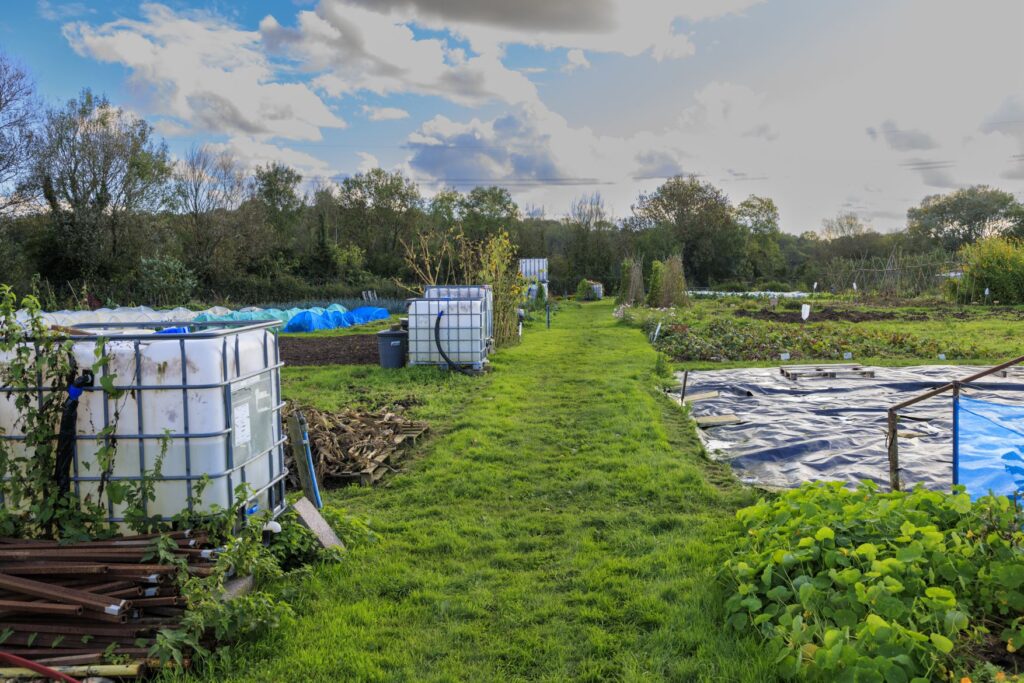
IBCs on the Farm today (photo credit: Steve Grundy)

Our grant

Our application to the Airport Community Health and Wellbeing Fund to upgrade our irrigation system was successful. We’ll be able to purchase new batteries, solar panels, and cabling for the pond and the Soft Fruit area extension. New IBCs will bring water even closer to the plots. Our Infrastructure (“A’) Team will do the installation, meaning that our application maximised our needs for equipment instead of labour.

The next phase of irrigation

The upgrade will make it possible to irrigate at night and in the early morning. This prevents the rapid evaporation that is currently experienced during daytime watering, particularly during very hot weather. Climate change events cause ever-more frequent and unpredictable heat waves which stress our crops and orchard trees so it’s important that we can water when and how it’s most effective.

Using solar for the system makes us less dependable on burning fossil fuels, making it more sustainable for Highbridge Community Farm and the environment, in line with our ethos.

The upgraded irrigation system will help our members too. All teams can rely on having access to IBCs that are reliably full of water, no matter when they come to the Farm to do their watering work. We’re not hanging up our watering cans just yet but more IBCs means that we can fill them closer to where the water is needed. We won’t have to carry them as far.

It takes a village …

Thanks to the HCF members who designed the irrigation system, to those who identified the funding opportunity and put the application together, to those who will manage the funding and procurement, and those who will work on site to make it happen. We really are a community working together.

Turning around our soil problems


You might think that loading your soil with compost, manure, or woodchip can only be a good thing, enriching it and adding to its ability to nourish crops? We thought the same – until Dr Andrew Ross took a closer look at our soil. It turns out that we’ve got a problem. Our soil has too much phosphorus and rapidly declining levels of potassium.

How did we get here? And, more importantly, what do we do next? Andrew Ross takes up the story.

Improving water retention with organic matter

When we were offered the Highbridge Community Farm field way back in February 2010, I took samples of the soil and analysed them in the College lab where I taught. They had between 4-6% organic matter in them. This was a fairly good level that held lots of nutrients for the plants.

But over the next few years, as we came across droughts and water shortages, we realised that more organic matter in the soil would act like a sponge and hold more water. So we chucked on the manure and compost and woodchip and our local council’s recycled green waste called Progrow. The organic matter level rose to 13% and we just about doubled the water holding capacity of the soil (about 90 litres per square metre in the top 30 cm when the soil is at capacity). 

Then came the first problem. Lots of swedes and turnips died. It turned out that the Progrow had raised the pH of the soil to 7.5-8. At that high pH level, the plants couldn’t absorb boron and they died of a shortage. We’ve managed to get the pH down to 6.9-7.2 and everything grew well again.

The phosphorus problem

In 2019, we decided to have some professional soil tests done. Since 2019, we have had the soil analysed every two years and plan to repeat the analysis in October this year. You can read about these analyses in a previous article here.

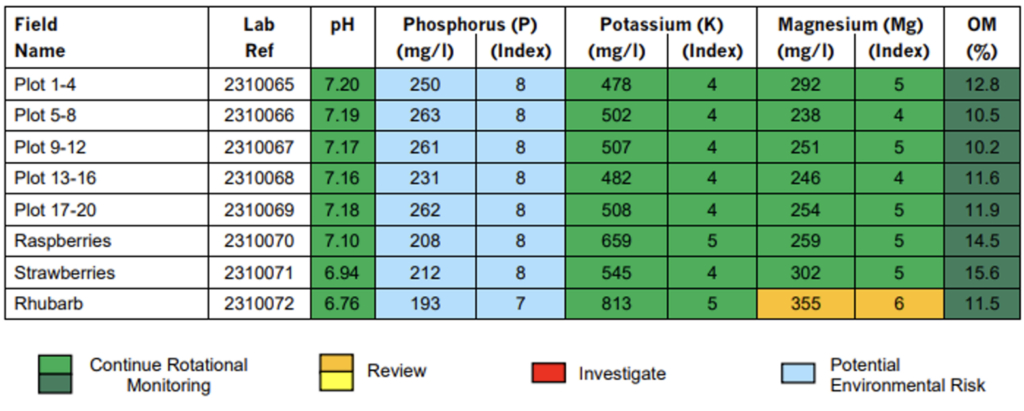
These soil tests revealed level 8 phosphorus. The scale goes up only to 9 and the target level for growing vegetables is level 3 so you can tell that we had a problem.

Figure 1. The latest set of soil test results (October 2024)

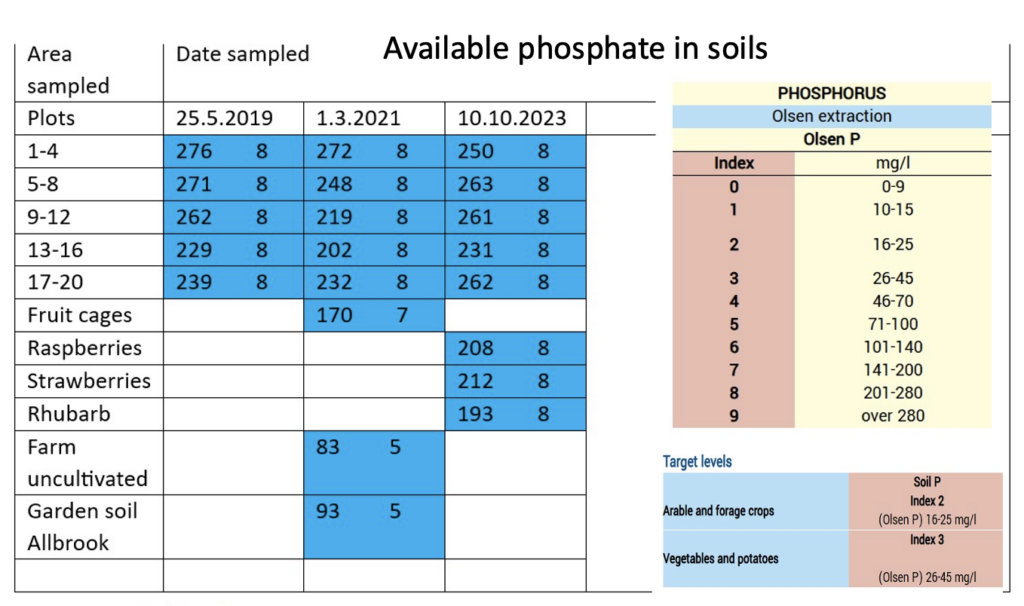
Figure 2 summarises the phosphate results for each set of tests. Plants don’t require lots of phosphate and, very often, fertilisers can contain a lot more phosphate than they need. Over the last five years, our plants have taken up some phosphate but not sufficiently to lower the levels in the soil. This is because of small additions of manure, compost or woodchip which seem to keep the phosphate level more or less steady.

Figure 2. The 3 sets of phosphate results in mg/l

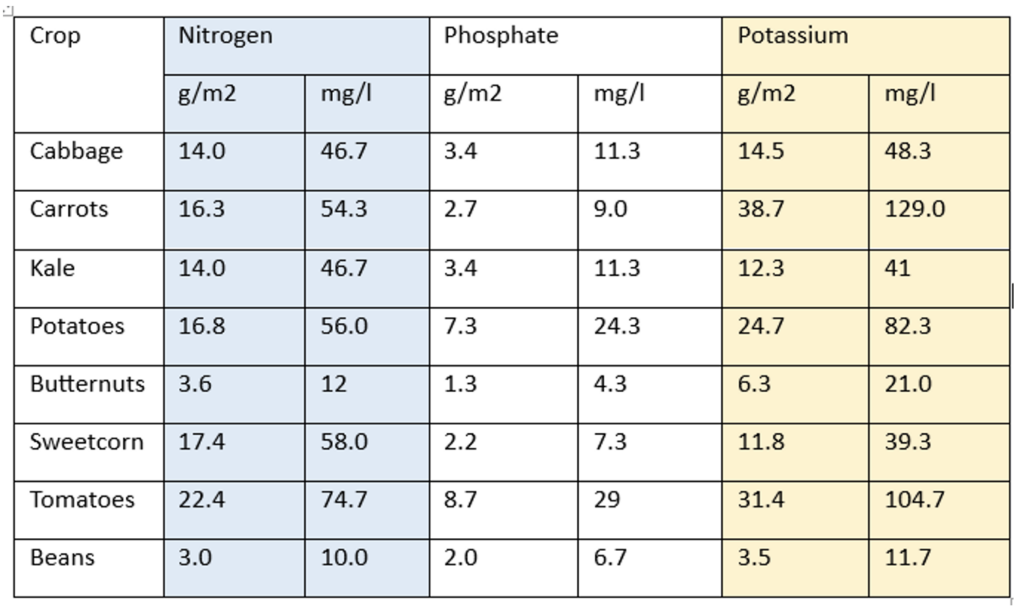
When crops like potatoes and tomatoes grow, they take up quite large quantities of phosphate as Figure 3 shows, but most of the other crops take up relatively little. If we keep adding materials to the soil, the phosphate level could rise further into the danger level of 9.

Figure 3. Nutrient removal by selected vegetables (adapted from New England Vegetable Management guide) in g per square metre of plot or mg per litre of soil.

Just four barrow loads more of compost

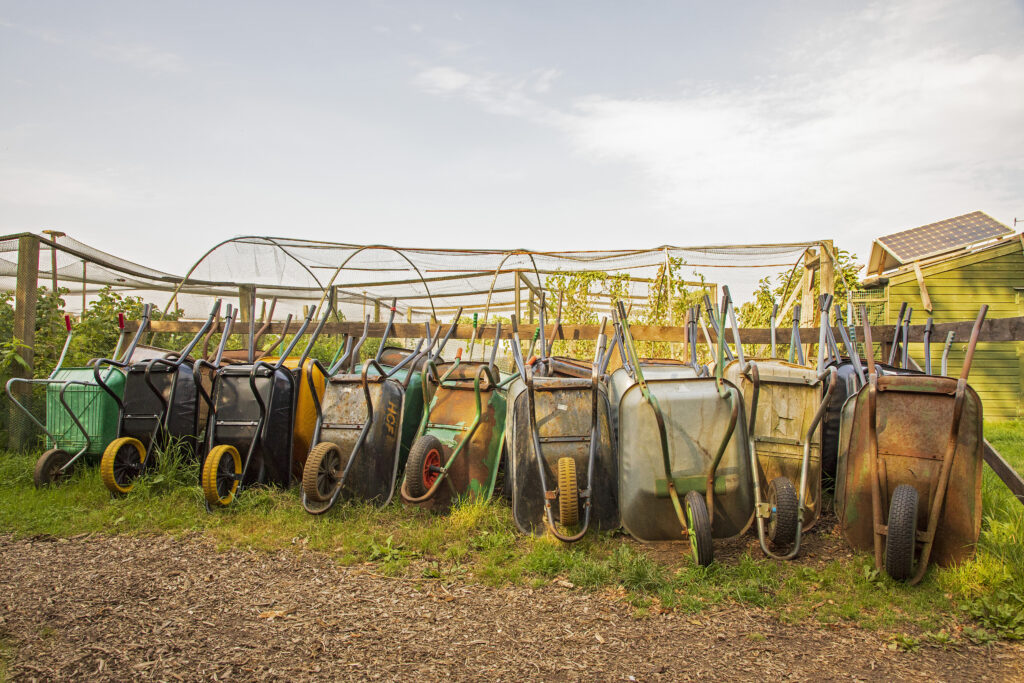
Photo: HCF wheelbarrows (Steve Grundy)

We have now worked out that if we added 4 barrow loads of compost (weighing 100 kg dry weight and containing 1% Nitrogen (N), 1% Phosphorus (P), 1% Potassium (K), which is typical of compost), then that load would contain 1 kg each of nitrogen and phosphorus and potassium. Spreading that over 200 m2 of a plot and mixing it with the soil to a depth of 30 cm will add 5g of each nutrient per sq m or 16.67 mg per litre of soil.

So putting just 4 barrow loads of compost could raise the phosphate level by 16.67 mg. If that had been done over plots 5-8 in October 2023, that would have raised their phosphate level to 279.7 which is dangerously close to the threshold of level 9 which is 280! And that is why we are trying to add as little compost or manure or woodchip to our plots as possible at this time.  

We know that if the phosphate concentration rises to level 9, plants can show calcium deficiency. They show this with browning and dying of new growth at the tips of leaves and roots and a reduced ability to absorb the micronutrients Iron and Zinc. (Iron deficiency in a plant is characterised by strong yellowing of young leaves.) In addition, there can be poor seed- and fruit production and a greater susceptibility to disease. These are not things that we want to happen and why we must continue to aim at reducing soil phosphate.

The potassium issue

We have the opposite issue with potassium. Plants take up lots of potassium from the soil. and some is washed down out of the soil by excessive rainfall, particularly if the soil is not covered with growing plants. Studies indicate that potassium lost by drainage from soil is approximately 0.5 g or 500 mg per square metre for every 100 mm of through drainage. We had 1000 mm of rain at the farm last year. That is one of the reasons why many teams are planting the cover crop Phacelia over the winter period. Phacelia keeps the soil covered and protects it from heavy rains which leech nutrients down, while pulling up washed-down nutrients with their deep roots. 

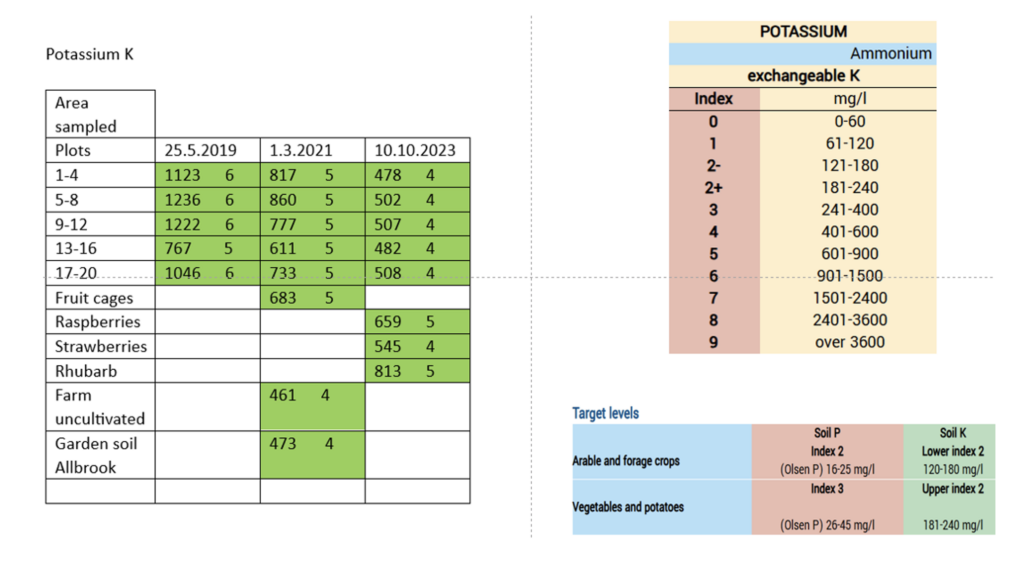
You can see from our results in Figure 5 that the potassium levels have gone down steadily from level 6 to level 5 then to level 4. By October this year, they could be as low as level 2+ which is as low as we would want them to go.

Figure 5. The three sets of potassium results

So, we might need to add potassium to some crops this summer or next year if we begin to see nutrient deficiencies in any of our crops. Plants respond to low potassium levels with leaves turning yellow, especially at the tips, or the margins will crinkle and curl. Then they might go brown and the tissue might die. Plants appear stunted and have poor flowering or fruiting.

Choosing a fertiliser

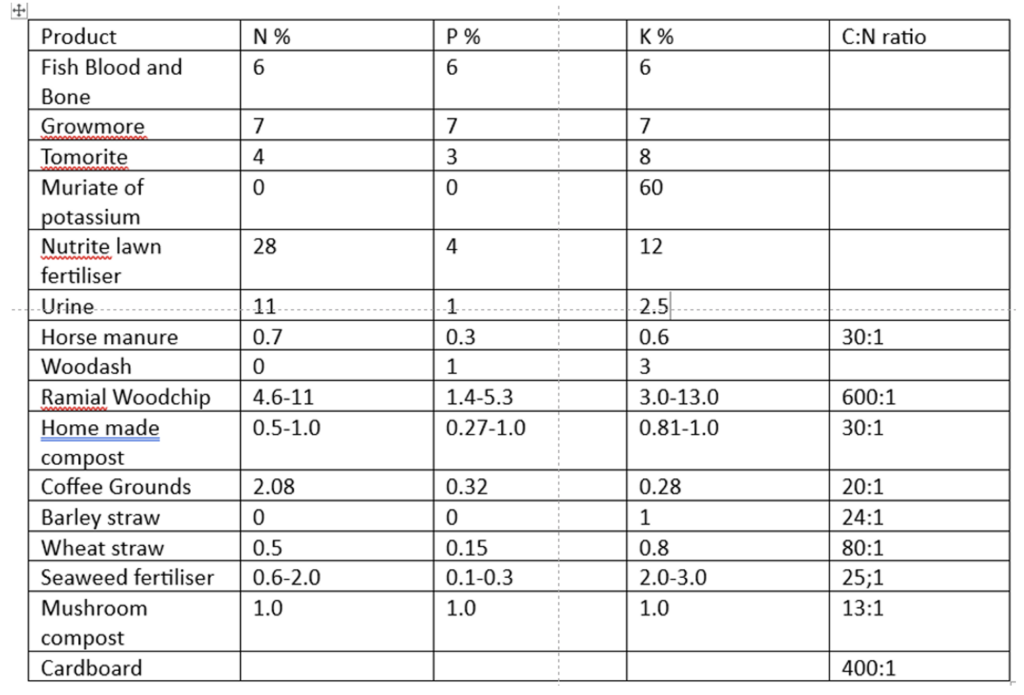
Figure 6. NPK levels in natural fertilisers (taken from a variety of sources)

The best fertiliser on the list is muriate of potash (potassium chloride), while potassium sulphate (0.0.50), potassium magnesium sulphate (0.0.22) and potassium nitrate (13.0.44) have large quantities of potassium.

But are these fertilisers organic? And does that matter? 

Of the other definitely-organic fertilisers in the table, seaweed fertiliser looks to have the greatest quantities of potassium while having low levels of phosphorus, so that may be the best alternative. And that’s a decision for HCF in the future. 

Thanks for reading.

As a community, we’re grateful for Andrew’s commitment to the science behind growing. The chemical analysis of our soil allows us to understand what’s happening in it and to explain the consequences for our plants. We can change the recommendations for the growing teams to give our soil the best chance to thrive. Ongoing testing will show whether we’re back on the right track and whether any more adjustments are needed.

Let us know your thoughts and questions.

Some useful references:

Is it an eater or a cooker? (And can I have some of the red apples, please?)

We are now entering the peak season for top fruit, and for the next two months, we’ll be harvesting loads of delicious apples and pears in dozens of varieties. As we lay out the trays, the most common question we get is, “Are they eaters or cookers?” Traditionally, people think of apples as either sweet, crisp, and juicy for eating or fluffy and somewhat bitter for baking.

But are we trapped into thinking inside the box?

Thanks to our orchards, you can explore beyond this Victorian reduction of apples into just two categories. Many of our cultivars serve both purposes, and in my opinion, an apple bake greatly benefits from a mix of many flavours.

Even more surprising is our persistent craving for any apple to be big and red. They are the first to go, and sometimes the only tray to go, on any market display while superior apples that don’t conform to this stereotype go untried. This expectation of our harvest to resemble highstreet market apples stops you from exploring and enjoying one of the biggest perks of our orchards: the sheer variety of cultivars and types at your fingertips. 

While I get the crunchy sweetness of a red Braeburn, my personal favourites are our russet apples for their nutty flavours and rugged texture. St Edmunds Pippins, Egremont Russet, or Cornish Gillyflower have the most amazing and complex tastes of the season. Others delight in the punch of the small Pitmanston Pineapples, the Pixies, or the lemony hints of the heritage Bardsey Island. The list is long!

So why not embrace the treat and privilege of having all these types to explore? 

Pick and mix your weekly share of apples from all that is on offer. The price of a mixed bag is the same per weight, but it’s so much more rewarding.

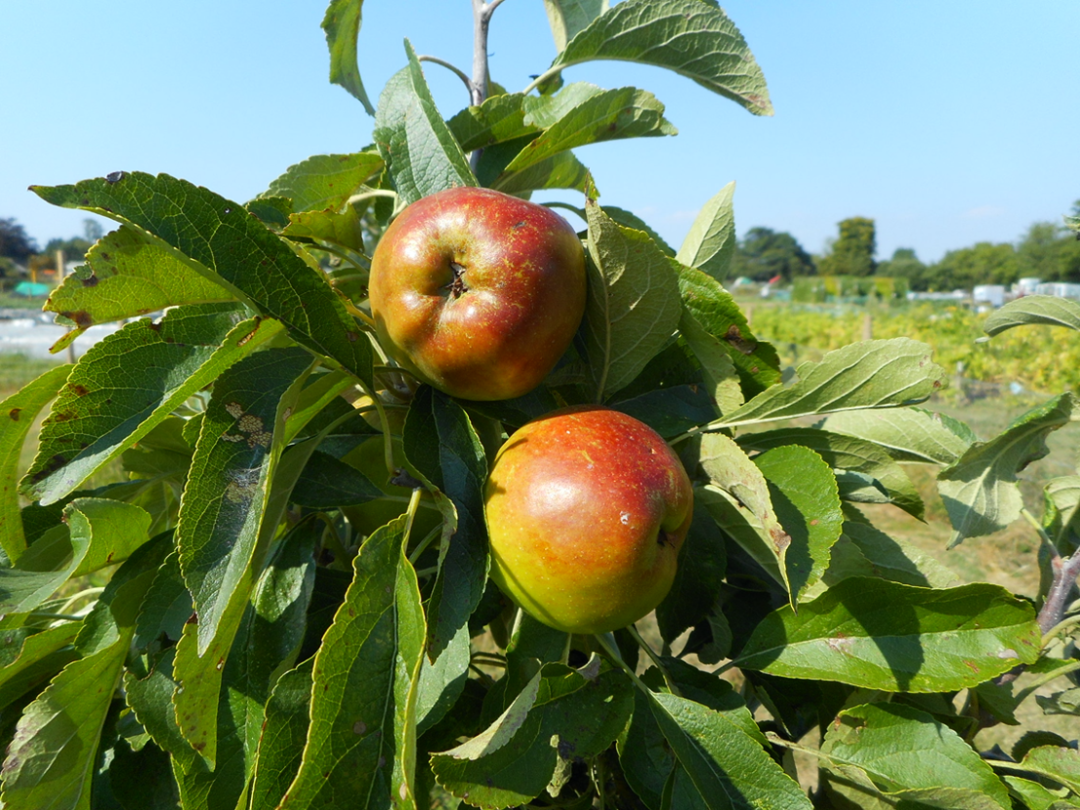
Photo: HCF apples (Steve Grundy)

Focus on fruit

Over the last 10 years, the soft fruit crops have grown from a simple bed of rhubarb to a pretty sophisticated set-up with irrigation, cages, and a wide range of varieties producing around a staggering 1300lbs of fruit each year. Find out more from Soft Fruit Team Leader, Helen, about the work of the team.

Establishing soft fruit

Fruit started at the Farm very simply. A rhubarb patch was started where the Herb Garden is now, using spares from members’ allotments. The first fruit cage was just a part of the raspberry cage that we have today. It contained raspberries, gooseberries, redcurrants, blackcurrants, and whitecurrants and a few strawberries. We have still have plants today from cuttings of those original bushes, except the whitecurrants which didn’t produce.

In 2015, HCF took over the land where the soft fruit is now and Andrew Ross started the original Fruit team. This kicked off two years of preparing the ground, preparing cages, establishing a drip irrigation system, and planting bushes. In 2017, the original rhubarb patch moved to a new home in the Soft Fruit area and other fruit crops developed around it.

A devastating lightning strike in 2019 destroyed the shed and took the nearby fruit cage and bushes with it. Falling bits of burning debris made things even worse. The team was down but not out. They cleared the mess, a new shed opened in 2020 and, since then, the Soft Fruit team has gone from strength to strength. 

Find your way to the Soft Fruit area from the plots. Photo: Steve Grundy

The team

The team is 11 people, led by Helen Ridley. 

Unlike the vegetable plots where the crops rotate and teams learn about new crops with each new year, the Soft Fruit team is more specialist. Team members are encouraged to take ongoing responsibility for a crop and learn about that crop over time. 

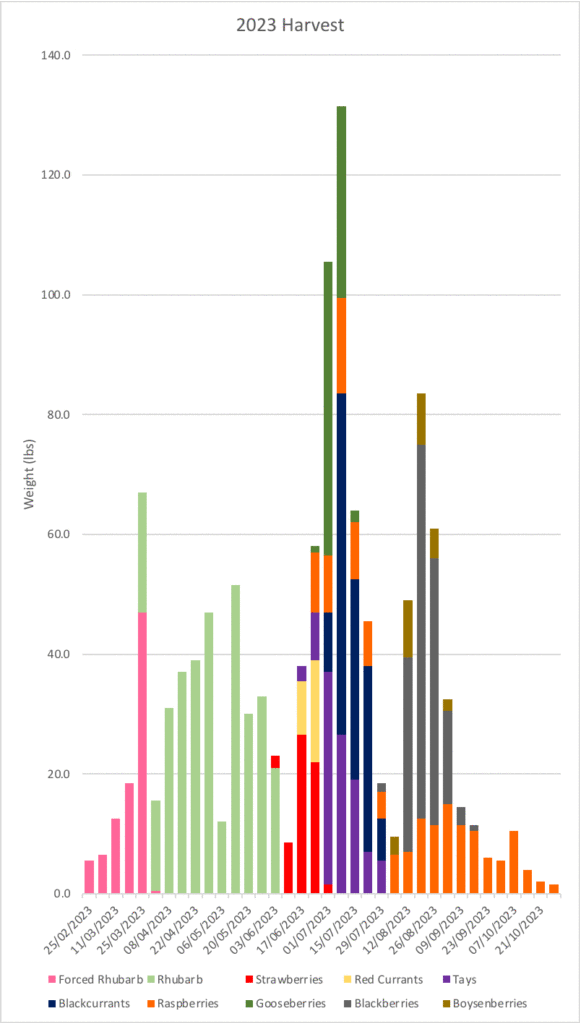
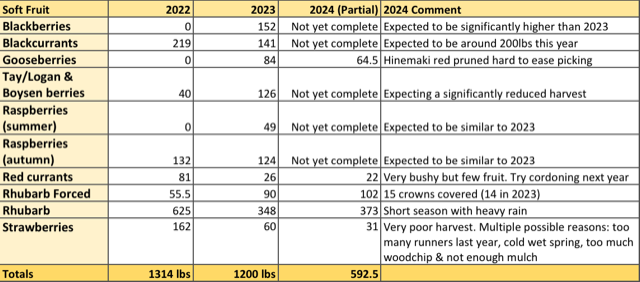
The team harvests non-stop between February and October – with July being a particularly critical month. They record the volume of fruit that they harvest so that they can see the performance of different crops, year-to-year. (You can see the summary from 2022 to now further on.) Between harvesting, the team maintains the fruit cages and internal plant supports, maintains paths around the cages, mulches the beds and deals with weeds. 

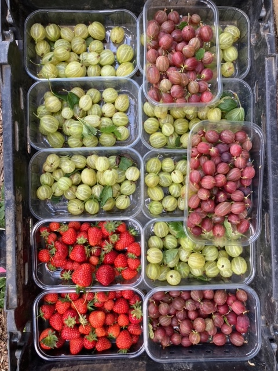
The amazing volume of fruit harvested last year

The fruit

Let’s take a closer look at what the team produces. It’s well over a thousand pounds of fruit each year!

Blackberries 

We’re all familiar with this hedgerow fruit. Even if you normally pick a good crop from local brambles, the Loch Ness variety produces large, sweet berries that are well worth a try. The team is expecting a good harvest this year from 9 new plants.

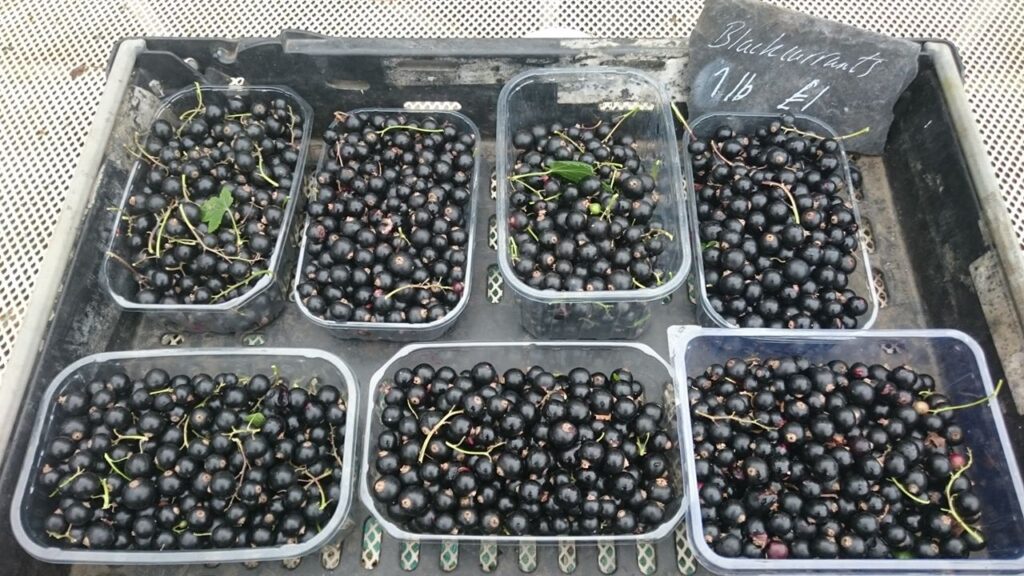
Blackcurrants

There are 25 blackcurrant bushes, 18 of which are the UK’s most popular variety of blackcurrants, Ben Hope. We’ve enjoyed a huge harvest from these – and thanks to people from other teams who joined in getting the bumper crop off the bushes.

Photo: Highbridge Community Farm

Boysenberries

You probably won’t find these in the shops. Their thin skins make them difficult to transport but you’ll enjoy their rich, jammy flavour. 

They are a mix of a European raspberry, a European blackberry, American dewberry (a species of blackberry), and a loganberry and their name comes from the man who developed them – one Rudolph Boysen.

Gooseberries 

Thorny bushes don’t make it easy to get the fruit but we’re glad of the sharp green berries (Leveller and Invicta) and their slightly sweeter red variety (Hinomaki Red). They can be plagued by gooseberry sawfly that strips the bush of its leaves, leading to a poor crop.  

Raspberries

We have Glen Ample summer and some unknown autumn varieties. Most patches are doing well, although there are a few stragglers. 

Redcurrants

These tart little berries made a poor harvest this year. The bushes needed a heavy prune last year and we didn’t feed with manure which could possibly have contributed. We visited RHS Wisley and found that they cordon the redcurrants (pruning to one main stem with short, fruiting side-shoots). Redcurrants can grow on old wood for 10 years, we were told, so we will experiment with this.

Rhubarb

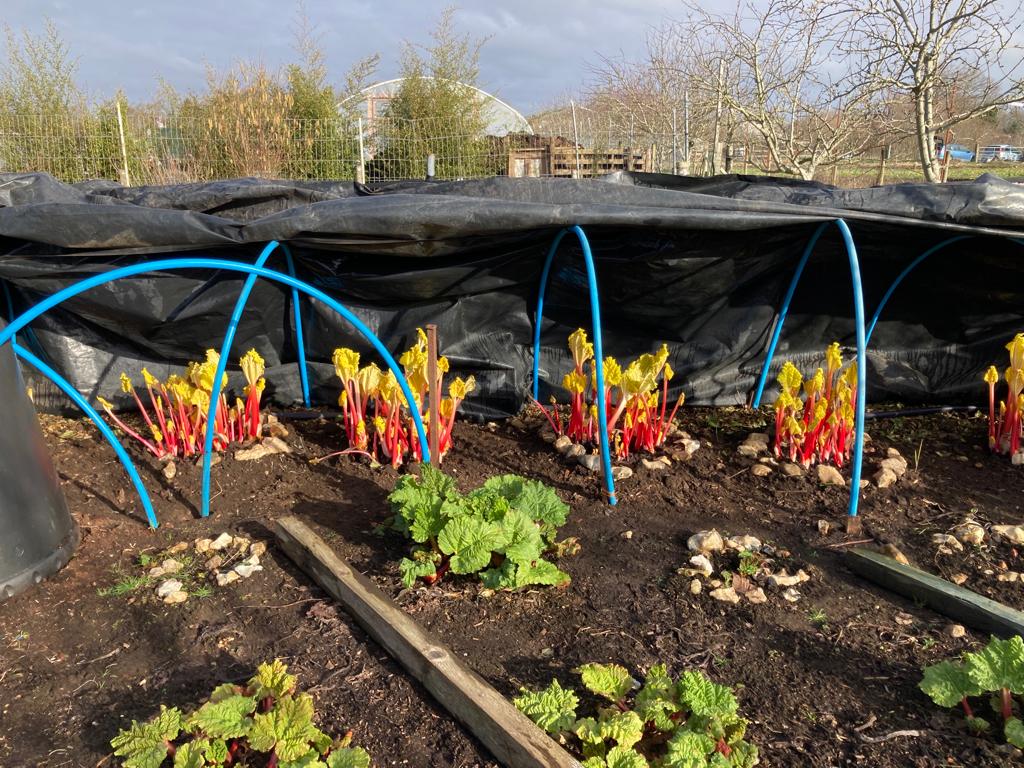
The plants are looking healthier now after a dip in June. The rhubarb is especially welcome in Spring when not many other fresh fruits and veg are available. We’ve had success in forcing the rhubarb , bringing us beautiful rosy spears early in the year. [Ed: we know that rhubarb is actually a vegetable but since most of us think of it with crumbles and fools rather than roast dinners or pasta, we’ll roll with its common association with fruit.]

Forced rhubarb! Photo: Highbridge Community Farm

Strawberries

We didn’t have a good harvest this year, possibly not enough feeding, too many runners last year, too much woodchip, or the cold wet Spring – but strawberries are very widely available outside the Farm so perhaps less missed than some of the more exclusive fruits. 

Tayberries and loganberries

These are crosses between red raspberries and blackberries, with the loganberry crossing continents as a hybrid of North American blackberry and European raspberry.  Like the boysenberry, the fruit is very soft and can only be harvested by hand so it’s not popular commercially. Both tayberry and loganberry have a fabulous aromatic flavour, with the loganberry being slightly sharper. 

Raspberry cane spot is a fungal disease and we had to prune hard last year to try to eliminate it. As a result, it’s likely to be a poor harvest this year. 

Adding it all up

Summary of soft fruit harvests 2022-now

Find out more

If you’re interested to know more about the HCF soft fruit, contact Helen. If you head over to the Soft Fruit area, there are team members working on different days and all will be happy to show you around

The A Team story

Can you imagine Highbridge Community Farm without sheds, water, polytunnels, fruit cages, tools, compost bins, cups of tea, somewhere to sit …? These are just a few of the things that our Infrastructure (“A”) Team take care of.

Initially, the guys worked on maintenance and construction alongside other responsibilities on the plots. Over time, Infrastructure became a team in its own right, acknowledging how important this aspect is to a successful farm project.

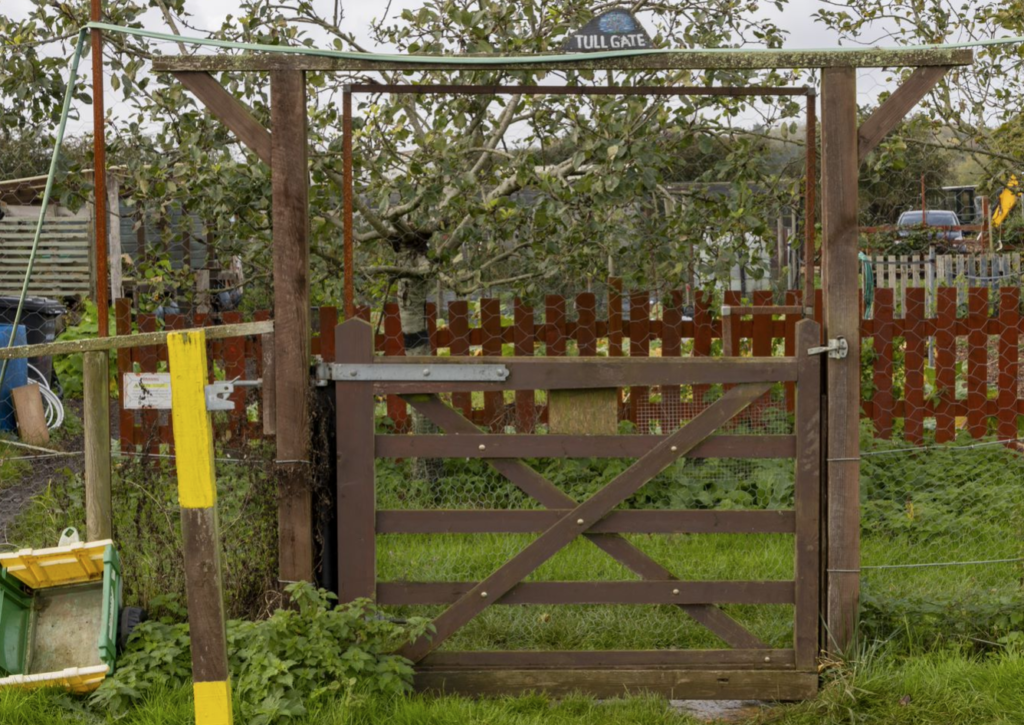
Brian Tull and Mike Lucas have documented the A Team story here. It describes how the team designed and built the structures that HCF needed to get started and then to keep pace as it grew and evolved.

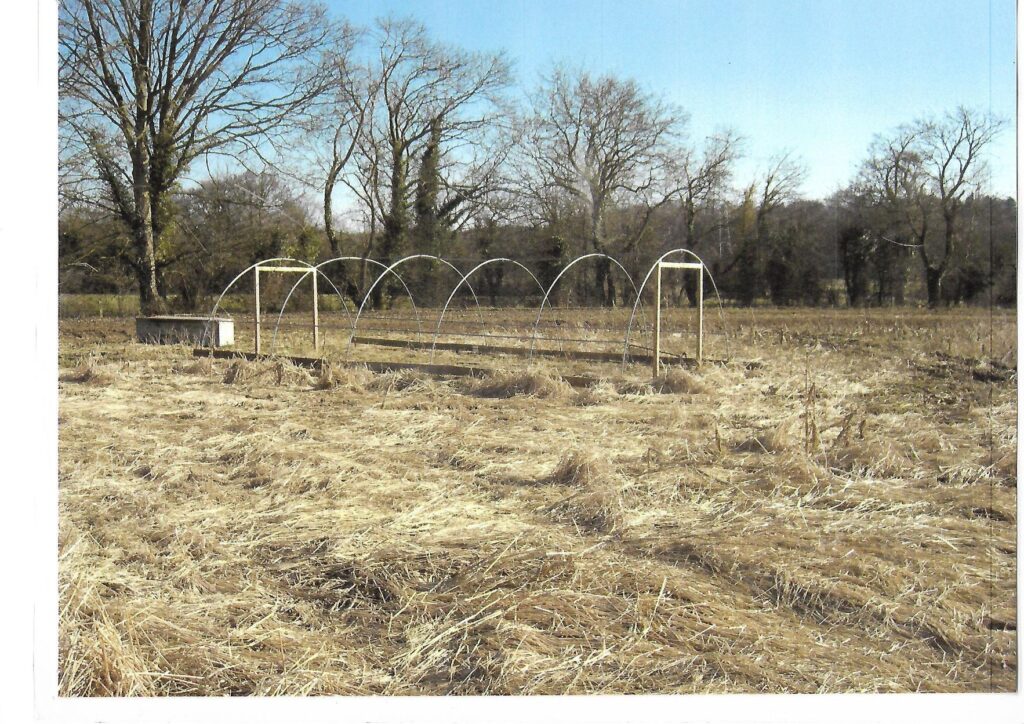
They’ve come a very long way since the first days of an empty, rough field!

Photo: Highbridge Community Farm

They’ve built polytunnels, storage for all manner of farm paraphenalia, fences, and communal areas. They’ve given us water pumps and IBCs, electricity, and a loo. They work within constraints determined by our landlord and they reuse where they can.

Their story reminds us how much work has gone into the infrastructure that we rely on. For members who’ve been here a while, you’ll be reminded of the old yellow marquee, tea breaks along the fence line, and the construction of the Big Green Shed.

Photo: Highbridge Community Farm

Find the A Team story, with plenty of photographs, on the “Our history” page of our website. While you’re there, take a look at the e-book that Andrew Ross put together.

We truly have a history and a community to be proud of.

Blast from the past

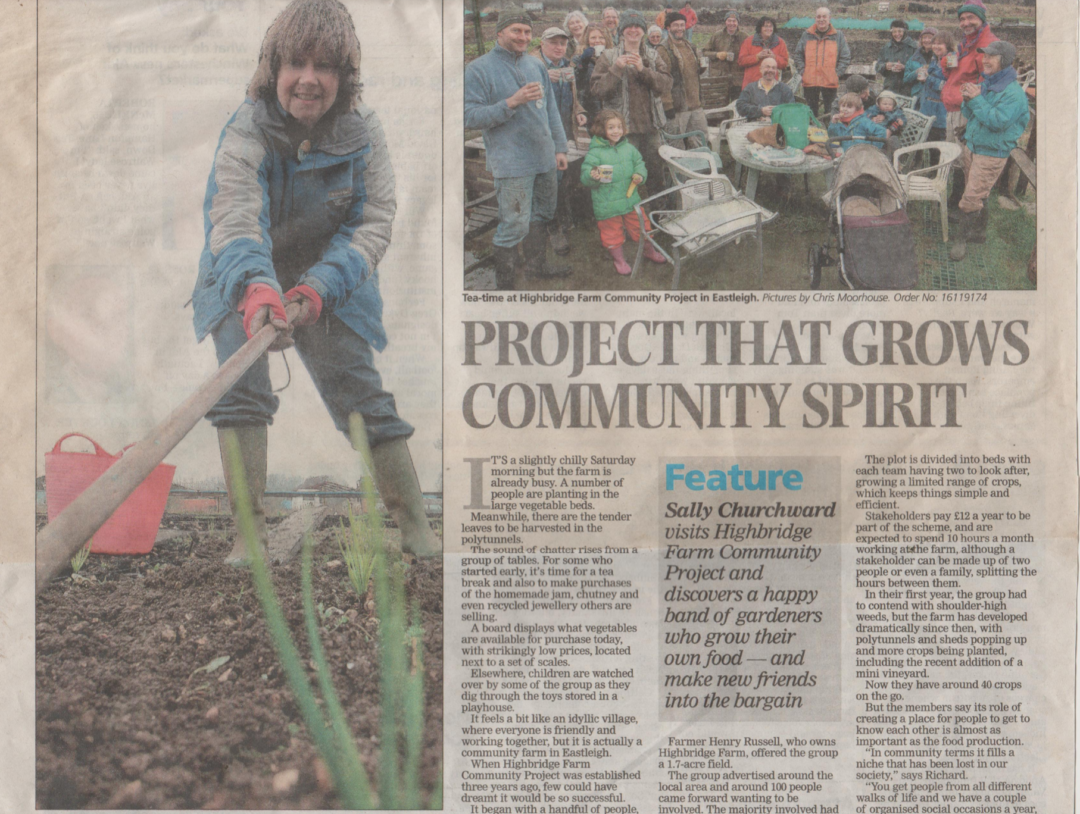
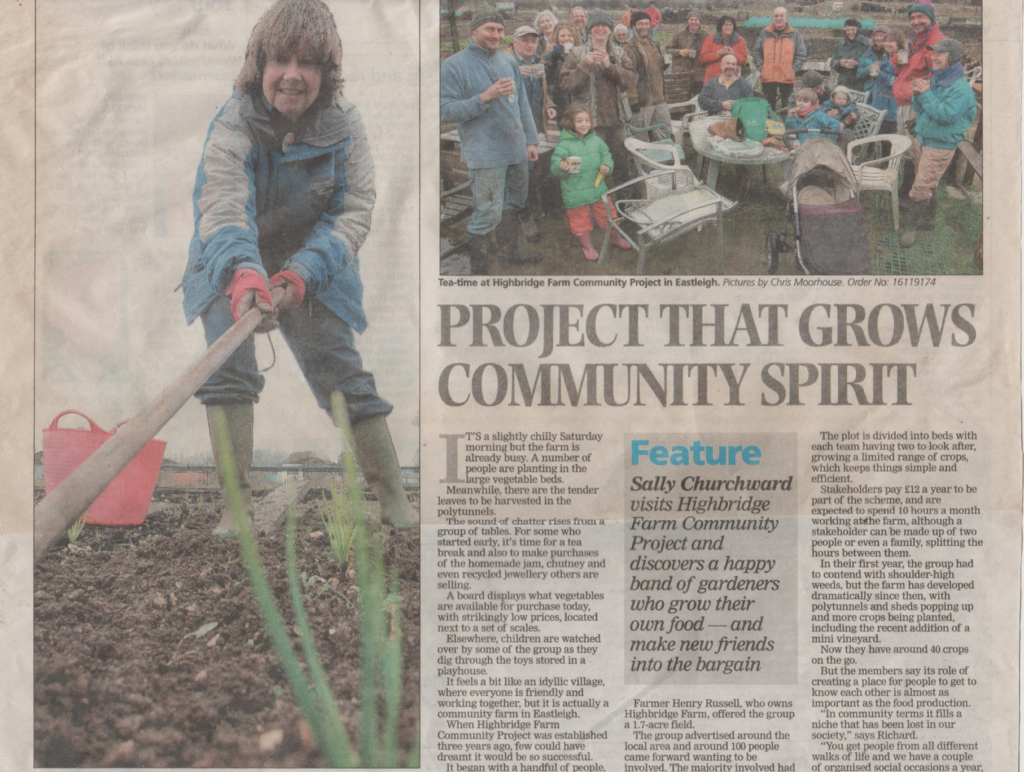
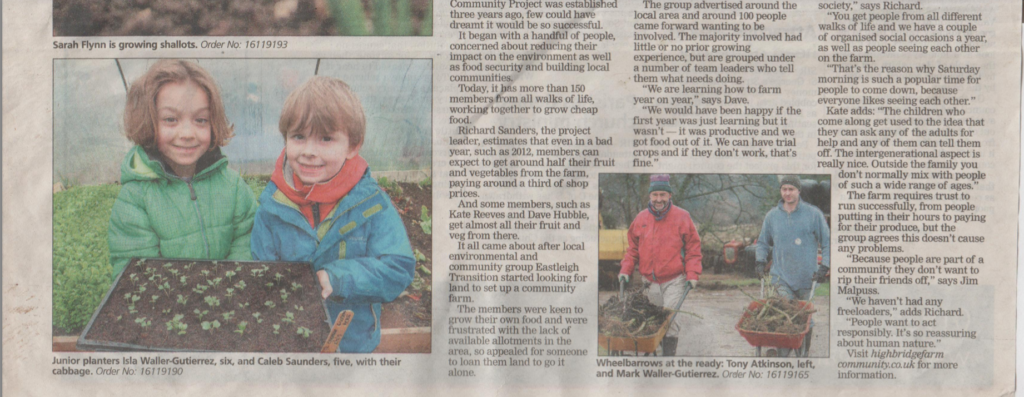
Check out this clipping from May 2013 as a lovely reminder of just how long our community farm has been thriving.

You’ll see some familiar faces and, if you look beyond the group in the photo, you’ll get a glimpse of the site. See how much it’s evolved!

To find out more about how HCF started and grew, have a look at Our history – and stand by for even more reflections. We’ll soon be adding Brian Tull’s history of the Infrastructure Team.

Thanks to Sarah and Brian for sharing this archive article – and here’s to our next decade!

Article: Hampshire Daily Echo https://www.dailyecho.co.uk/news/10357364.highbridge-community-farm-is-growing-food-and-friendships/